

Balanced Advantage Fund
What are Balanced Advantage Funds?
Balanced Advantage funds are hybrid mutual funds which is also known as Dynamic Asset Allocation Funds. In a Balanced Advantage fund, the asset allocation between the two asset classes - equity and debt - is managed dynamically depending on the prevailing stock market conditions.
For example – If the stock prices are high, the fund manager may tilt the asset allocation more towards debt and when stock prices are low, the tilt can shift more towards equities. Generally, the fund manager, utilizes a process driven approach (also known as asset allocation model) to shift the portfolio between the two assets, equity and debt, depending on the market conditions. This is the reason, when stock prices are very high, the investors do not see a big fall in their investment value as maximum investment would be in debt securities. Likewise, investors can gain maximum when the markets recover as the fund manager would have allocated higher into equities when the markets were low.
In summary, fund managers of balanced advantage fund shifts the asset allocation based on market valuation – shift to equity when valuation is low and shift back to debt when valuation is high. The aim of dynamic asset allocation is to reduce downside risk and generate superior risk adjusted returns for investors.
What asset allocation models are used by Balanced Advantage funds?
Asset Management Companies have their in-house mathematical models which decides equity and debt allocations depending on market conditions. Generally, these models are created based on the fund manager’s hypothesis of asset allocation at different valuation levels which can generate superior returns for investors over a long investment horizon. Fund managers duly back-test these models using historical data to see if the funds’ investment objectives can be met.
- Counter-cyclical model: This model increases equity allocation by reducing debt allocation in falling markets and reduce equity allocations in rising markets. These models endeavours to buy low and sell high. However, different fund managers may use different valuation metrics for dynamic asset allocation e.g. P/E, P/B etc.
- Pro-cyclical model: Pro-cyclical models essentially try to follow the market trend and thus increase equity allocation in rising markets while reduce it in falling markets. Pro-cyclical models are based on market trend indicator like daily moving averages and indicators of the trend strength / health (Standard Deviation, Downside Deviation etc.). Some pro-cyclical models may use other factors like valuations, macro-economic factors etc.
How derivatives is used in Balanced Advantage Funds?
- Derivatives are used to manage active equity exposure through hedging which helps the fund managers to keep gross equity exposure above 65% so that investors can avail equity taxation. This is done while keeping in mind the asset allocation determined by the model.
- The other reason for using derivatives is to generate returns for investors through arbitrage opportunities. As you may know, Arbitrage are risk free profits made by the scheme by exploiting price differences between the spot (cash) and the derivatives (Futures and Options) segments of the market.
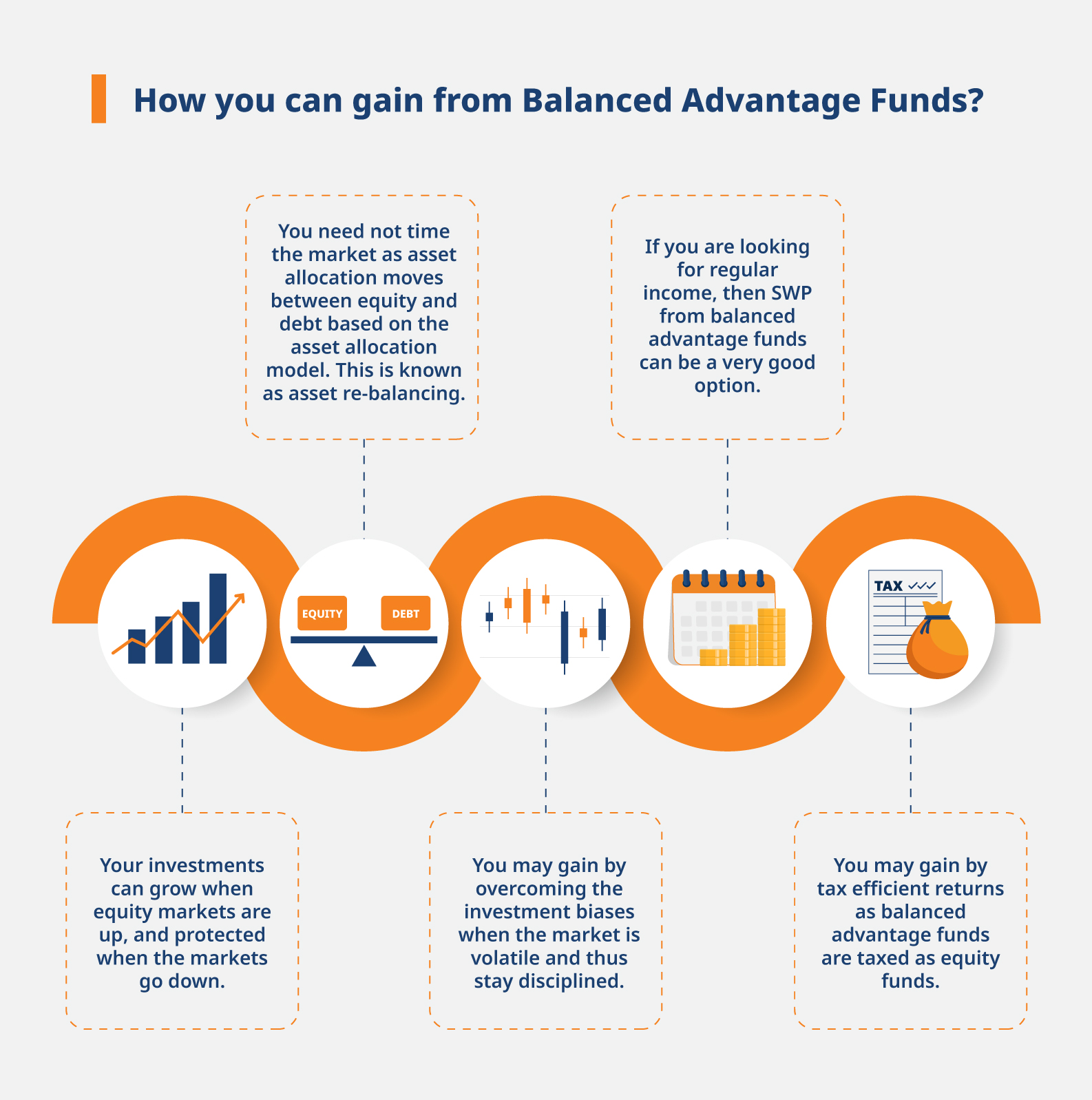
Balanced Advantage Funds help investors achieve a balance between growth and stability by dynamically allocating investments between equity and debt. These funds can participate in market upswings while offering protection during downturns through automatic asset rebalancing. Investors do not need to time the market, as the fund adjusts allocations based on market conditions. The strategy also helps reduce emotional investment decisions during volatile periods, supports regular income through Systematic Withdrawal Plans (SWPs), and may provide tax-efficient returns since these funds are generally taxed as equity funds.
What are the risks?
- In the short term, the fund can give negative returns due to the equity holdings in the portfolio.
- Therefore, investors should have minimum 3+ years of investment horizon for investing in these funds.
Things an investor should consider for Balanced Advantage Funds?
Risk: Even though these funds have considerable percentage allocation in debt securities, they are not entirely risk free. The reason is equity components, which makes balanced advantage funds vulnerable to equity market risks. This makes the NAVs fluctuate as per the market movements. However, balanced advantage funds are less risky compared to pure equity funds.
Return: The returns of balanced advantage funds would not be like pure equity funds, but perhaps higher than that of fixed income funds. If you are a moderately aggressive investor, you can expect relatively good returns provided you have minimum 3-5 years of investment horizon.
Financial Goals: If you do not like high risk, balanced advantage funds can be ideal for meeting your medium to long term goals as these funds can generate relatively good returns in the long term and are also tax efficient compared to assured income products / or fixed income funds.
Investment horizon: You should have minimum 3-5 years of investment horizon for investing in balanced advantage funds. Investors with lower than 3 years of investment horizon, should not invest in these funds.
What is the taxation for Balanced Advantage Funds?
As mentioned earlier, most of the balanced advantage funds in India are taxed as equity funds. In equity oriented funds, short term capital gains (investment held for <12 months) are taxed at 15% while long term capital gains (investment held >12 months) are tax exempt up to Rs 1 Lakh in a financial year. Capital gains in excess of Rs 1 Lakh are taxed at 10% only + Cess. The tax advantage of balanced advantage funds may be beneficial for investors who predominantly invest in fixed income investments.
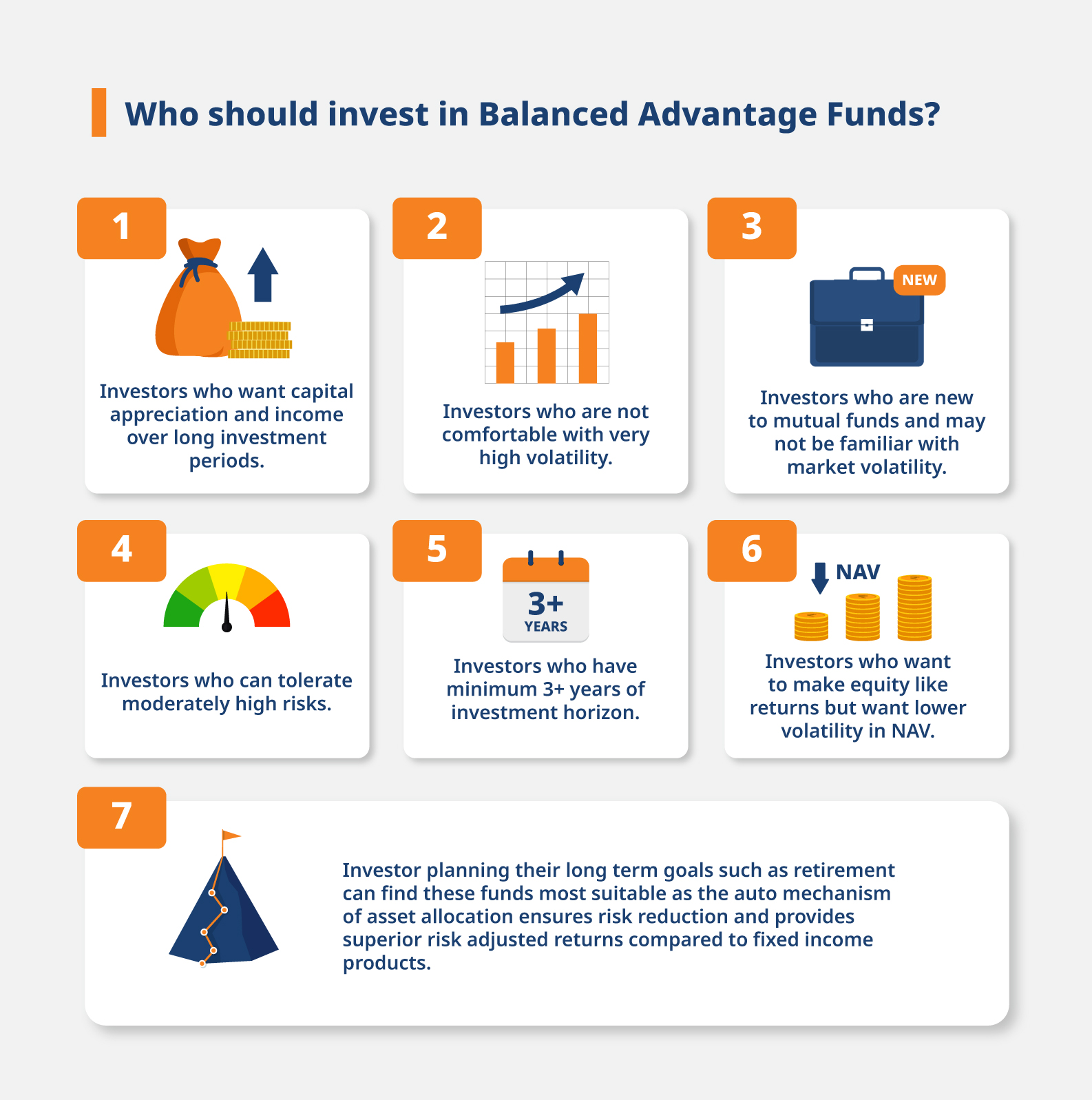
Balanced Advantage Funds are suitable for investors seeking a combination of capital appreciation and income over the long term while avoiding the challenges of extreme market volatility. These funds can be a good choice for new mutual fund investors, individuals with a moderate risk appetite, and those with an investment horizon of at least three years. They are also appropriate for investors who want equity-like returns with relatively lower NAV fluctuations. For long-term financial goals such as retirement, the automatic asset allocation feature helps manage risk and aims to deliver better risk-adjusted returns compared to traditional fixed-income products.
Articles

What are balanced advantage funds?
Balanced advantage meaning a type of hybrid mutual funds which invest in equity and fixed income asset classes. The asset allocation (i.e. mix of equity and fixed income in the portfolio) of balanced advantage funds changes dynamically according to market conditions.
Read More
What is an effective balanced advantage fund?
Emotions and instincts often guide investment decisions, but they can be harmful for your financial interests. For example, age old investing wisdom is buying low and selling high. However, instead of “buying low and selling high” investors usually buy when market is high, thinking it will go higher.
Read MoreFor information on one-time KYC (Know Your Customer) process, Registered Mutual Funds and procedure to lodge a complaint in case of any grievance Click here!
Mutual Fund investments are subject to market risks, read all scheme related documents carefully.