Debt funds are fixed income mutual fund schemes which invest in debt and money market instruments like CPs, CDs, Corporate Bond, T-Bills, G-Secs etc. These instruments pay interest (coupon) at pre defined intervals and the face value (principal) upon maturity. The yields of many of these instruments are usually higher than bank FD interest rates of similar maturities. Yields of AAA rated corporate bonds can be 150 – 200 bps higher than FD interest rates. In addition to higher yields, since these instruments are traded in the market, you can benefit from price appreciation. The chart below shows the trailing returns of different debt fund categories over different tenures.
Based on historical data, you can see that across different product categories (risk profiles) and investment tenures, debt funds have the potential to give better returns than bank FDs.
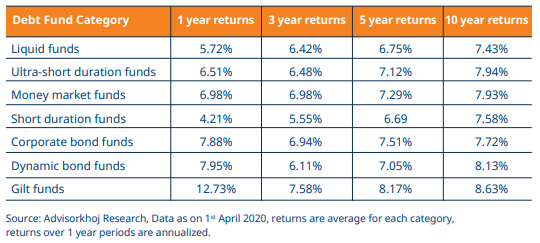
The image is a table comparing average annualized returns across seven debt fund categories over 1-year, 3-year, 5-year, and 10-year investment periods. The columns show returns for each time horizon, and the rows list the debt fund categories. Liquid Funds returned 5.72% over 1 year, 6.42% over 3 years, 6.75% over 5 years, and 7.43% over 10 years. Ultra-Short Duration Funds returned 6.51%, 6.48%, 7.12%, and 7.94% over the same periods. Money Market Funds returned 6.98%, 6.98%, 7.29%, and 7.93%. Short Duration Funds returned 4.21%, 5.55%, 6.69%, and 7.58%. Corporate Bond Funds returned 7.88%, 6.94%, 7.51%, and 7.72%. Dynamic Bond Funds returned 7.95%, 6.11%, 7.05%, and 8.13%. Gilt Funds delivered the highest 1-year return at 12.73% and returned 7.58%, 8.17%, and 8.63% over 3-year, 5-year, and 10-year periods respectively. The table shows that returns vary across debt fund categories and investment horizons. Gilt Funds achieved the strongest short-term performance, while most other categories produced returns generally ranging from about 6% to 8% across longer investment periods. Source: Advisorkhoj Research. Data as of 1 April 2020. Returns are category averages, and returns for periods longer than one year are annualized.
Past performance may or may sustain in future. The returns shown above are returns of the category and do not in any way depict the performance of any individual scheme of any Fund.
Bank FD interest is taxed as per the income tax rate of the investor. Capital gains in debt funds held for over three years are taxed at 20% after allowing for indexation benefits. Indexation benefits can reduce tax obligations substantially for investors in higher tax brackets. Incidence of taxation in fixed income funds arise only if you redeem (sell) your mutual fund units or if you receive dividends. Capital gains on your redemption proceeds and dividends are taxed differently.
There are two kinds of capital gains in fixed income funds:-
Illustration of Long Term Capital Gains-
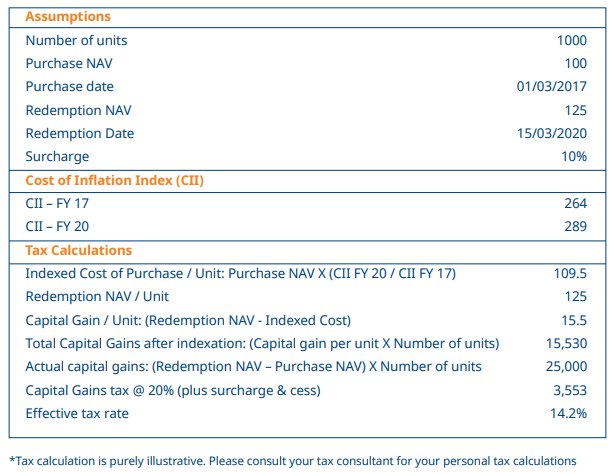
The image presents an illustrative example of calculating capital gains tax using indexation. The example assumes an investment of 1,000 units purchased at a Net Asset Value (NAV) of 100 on 1 March 2017 and redeemed at a NAV of 125 on 15 March 2020. A surcharge of 10% is applied. The Cost Inflation Index (CII) used in the calculation is 264 for Financial Year 2016-17 and 289 for Financial Year 2019-20. Using these values, the indexed cost of purchase per unit is calculated as 109.5. With a redemption value of 125 per unit, the indexed capital gain is 15.5 per unit. The total capital gain after indexation is calculated as 15,530, compared with an actual capital gain of 25,000 before indexation. Applying capital gains tax at 20%, plus surcharge and cess, results in a tax amount of 3,553. The effective tax rate is shown as 14.2%. The example demonstrates how indexation adjusts the purchase cost for inflation, reducing the taxable capital gain and lowering the effective tax burden compared to taxation on the nominal gain.
If you received the same maturity amount from a bank FD, then your tax outdo would have been Rs 8,280 if you were in the 30% tax bracket (plus surcharge & cess). The long term capital gains tax in the example above is nearly 60% less.
Prior to this financial year, mutual fund dividends were tax free in the hands of the investors but the scheme (AMC) had to pay dividend distribution tax (DDT) at the rate of 29.12% for debt funds before paying dividends to investors. In this Union Budget, the Government has abolished DDT. Dividends will now be added to your income and taxed as per your income tax slab. If you are in the 30% tax bracket, your post tax dividend will now be lower (assuming same dividend payout rate per unit), but if you are in the lower tax brackets your post tax dividends will be higher. You should decide whether to invest in growth or dividend re-investment option depending on your individual tax situations.
Disclaimer:
An Investor Education and Awareness Initiative by Mirae Asset Mutual Fund. All Mutual Fund investors have to go through a one-time KYC (Know Your Customer) including the process for change in address, Phone number, bank details, etc. Investors should deal only with registered Mutual Funds details of which can be verified on SEBI website (https://www.sebi.gov.in) under ‘Intermediaries /Market Infrastructure Institutions’. For further information on KYC, RMFs and procedure to lodge a complaint in case of any grievance, you may refer the Knowledge Centre section available on the website of Mirae Asset Mutual Fund. Investors may lodge complaints on https://www.scores.gov.in against registered intermediaries if they are unsatisfied with the responses. SCORES facilitate you to lodge your complaint online with SEBI and subsequently view its status.
Mutual Fund investments are subject to market risks, read all scheme related documents carefully.

 ETF Website