Risk and returns are directly related but risk is a double edged sword. If you take too little risk, you may not be able to make the money needed for your financial goals. On the other hand, if you take too much risk, you will expose your financial goals to uncertainties of capital markets. Right asset allocation means that you take the optimal amount of risk to meet your short term, medium term or long term financial goals.
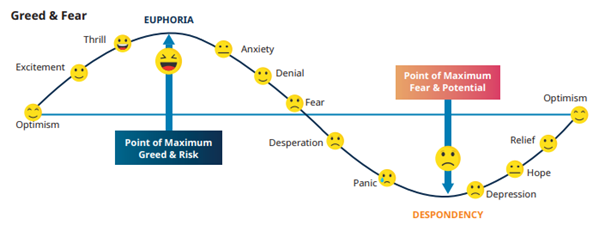
The image illustrates the investor psychology cycle known as the "Greed and Fear" cycle. A curved wave tracks investor sentiment through different market phases. The cycle begins with Optimism, followed by Excitement and Thrill, and reaches a peak labeled Euphoria. At this point, a highlighted marker identifies the "Point of Maximum Greed & Risk," indicating a stage where investors may take excessive risk due to strong market optimism. After the peak, the cycle moves downward through Anxiety, Denial, Fear, and Desperation, eventually reaching Panic. The lowest point of the cycle is labeled Despondency and is identified as the "Point of Maximum Fear & Potential," suggesting a stage where investor fear is highest and potential investment opportunities may be greatest. The cycle then begins to recover through Hope and Relief before returning to Optimism, completing the pattern. The diagram demonstrates how investor behavior and decision-making are often influenced by emotional extremes of greed during rising markets and fear during declining markets.
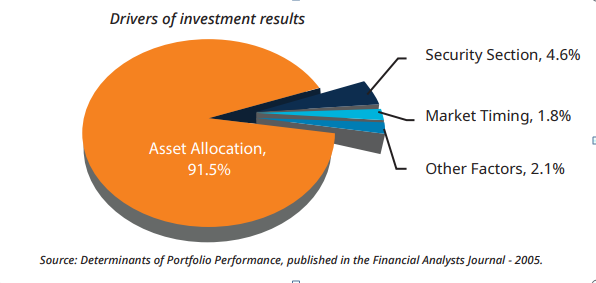
The image is a pie chart titled "Drivers of investment results." The chart illustrates the relative contribution of factors that influence portfolio performance. Asset Allocation represents the largest portion of the chart, accounting for 91.5% of investment results. The remaining contributors are much smaller, with Security Selection accounting for 4.6%, Other Factors accounting for 2.1%, and Market Timing accounting for 1.8%. The chart emphasizes that asset allocation, or the decision of how investments are distributed among different asset classes, has a substantially greater impact on long-term investment outcomes than security selection, market timing, or other factors. The visual highlights the dominant role of asset allocation in determining portfolio performance. Source: Determinants of Portfolio Performance, published in the Financial Analysts Journal, 2005.
Disclaimer:
An Investor Education and Awareness Initiative by Mirae Asset Mutual Fund. All Mutual Fund investors have to go through a one-time KYC (Know Your Customer) including the process for change in address, Phone number, bank details, etc. Investors should deal only with registered Mutual Funds details of which can be verified on SEBI website (https://www.sebi.gov.in) under ‘Intermediaries /Market Infrastructure Institutions’. For further information on KYC, RMFs and procedure to lodge a complaint in case of any grievance, you may refer the Knowledge Centre section available on the website of Mirae Asset Mutual Fund. Investors may lodge complaints on https://www.scores.gov.in against registered intermediaries if they are unsatisfied with the responses. SCORES facilitate you to lodge your complaint online with SEBI and subsequently view its status.
Mutual Fund investments are subject to market risks, read all scheme related documents carefully.
 ETF Website